Antique vs Vintage: How Old Does Something Have to Be?
In this weeks Antiques Central blog we address one of the most commonly asked questions in the antiques and vintage world.
Few questions are asked more often — and fewer still are answered properly!
“Is this an antique?”
“No, it’s vintage.”
“Well… it feels old.”
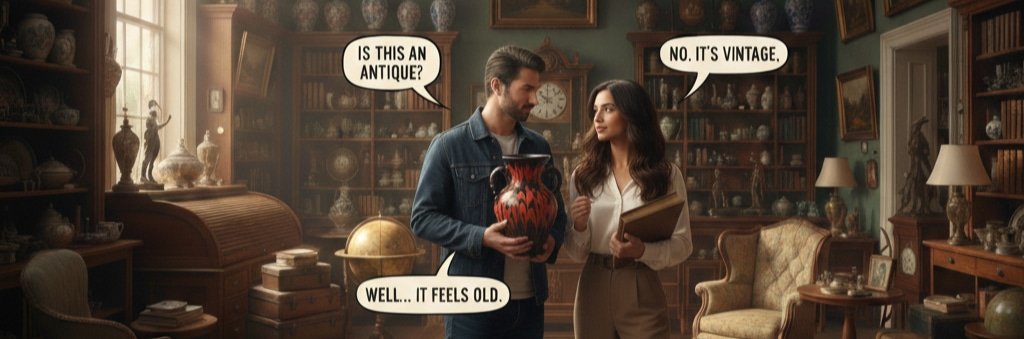
That uncertainty is not accidental. The antique and vintage trade has always lived in the space between calendar years, cultural memory and market behaviour. Age matters — but it is not the whole story.
Let’s cut through the noise and explain this clearly, accurately and without modern blah blah and fluff.
The One Rule That Has Never Changed: What Is an Antique?
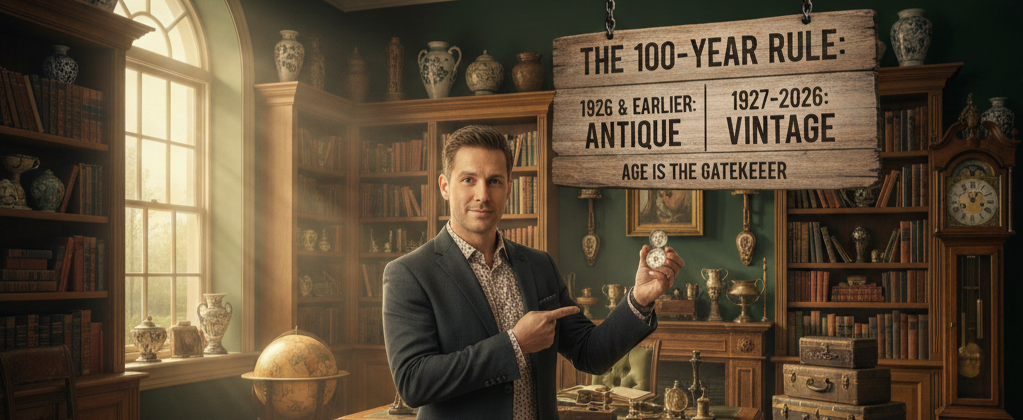
Quite simply, an antique is an object that is at least 100 years old.
That definition is not a trend.
It is not a guideline.
It is not a marketing term.
It is a long-standing international convention used by:
Auction houses
Museums
Customs authorities
Insurance companies
Professional dealers
If an object was made in 1926 or earlier, it qualifies as an antique in 2026.
If an object was made in 1926 or earlier, it qualifies as an antique in 2026.
Anything younger than 100 years is not an antique — no matter how rare, beautiful, or valuable it may be.
That clarity is important, because in recent years the word antique has been stretched, diluted and misused online. Age is the gatekeeper. Always has been.
What Is Vintage?
This is where things become more interesting — and more nuanced.
If an Antique is 100 years of age or older, then Vintage generally refers to items made between 20 and 99 years ago.
But unlike “antique,” vintage is not a legally fixed term. It is a cultural and market definition, shaped by nostalgia, design movements, and generational memory.
In practice, vintage items usually fall into these bands:
20–39 years old: Late 20th-century / early nostalgia
40–69 years old: Core vintage (high demand)
70–99 years old: Pre-antique or “near-antique”
This is why objects from the 1950s to 1980s dominate today’s vintage market. They sit at the intersection of:
Recognisable design
Surviving condition
Emotional connection
Vintage is about context, not just chronology.

Why the Confusion Exists (And Always Will)
The confusion between antique and vintage isn’t ignorance — it’s evolution.
Each generation redefines “old” based on what it remembers.
To someone born in 2000:
A 1980s object feels ancient
A rotary phone looks museum-ready
But markets don’t run on feelings. They run on definitions, precedent and trust.
Calling a 1970s item an antique is not harmless enthusiasm — it is factually wrong. And experienced buyers know it instantly.

What About “Retro”, “Collectable”, and “Mid-Century”?
These terms often appear when sellers avoid age clarity.
Retro: Newly made items styled to look old
Collectable: Desirable, but any age
Mid-Century: Design period (roughly 1945–1969), not a guarantee of age or value
None of these replace antique or vintage. They describe style, not status.
Does Age Equal Value?
Absolutely not.
Some antiques are modestly priced.
Some vintage items are worth more than many antiques.
Value is driven by:
Condition
Rarity
Provenance
Demand
Design relevance
Age qualifies an object.
The market decides its worth.

The Hard Truth Dealers Rarely Say
If something is:
Under 100 years old
Marketed as an antique
Vaguely described
Heavily polished
Poorly identified
Then it deserves scrutiny.
The strongest dealers don’t exaggerate age. They let accuracy do the selling.
The Simple Rule to Remember
If you remember only one thing, make it this:
Antique = 100 years or older
Vintage = 20 to 99 years old
Everything else is commentary.
Thanks for reading the Antiques Central Blog.
Mark Ray
