Exporting History for Profit! Legal, Ethical or Just Wrong?
Join me in this week’s blog as we reveal the controversy surrounding the export of culturally significant antiques and vintage.
If you would prefer to watch the podcast on the Antiques Central YouTube channel, click here.

Culturally significant artefacts carry meaning far beyond their market value.
As sellers or buyers of antiques and vintage, a fascinating question we all need to ask ourselves is: ‘Should antique and vintage treasures be sold and exported to other countries for profit?’
In other words, should the antiques and vintage trade operate in an independent free market zone — or should dealers, buyers and the establishment have a moral, cultural and legal duty to keep historically valuable artefacts in the country they originate from?
Now, let’s be clear — I’m not talking about mass-produced antique and vintage bric-a-brac or low-end collectibles, the kind of stock that fills up every antique store you visit. There’s nothing wrong with it, but there’s more than enough of that to go round several times over. What I’m talking about is the high-end, culturally important artefacts deeply rooted in a country’s social history. So today, we’re going to tear up assumptions, challenge conventions and confront the questions some dealers prefer to ignore. By the end of this blog, you won’t just have your own personal opinions and questions. Hopefully, you’ll have some answers — answers that are factual, to the point, sometimes uncomfortable — and I suspect a few of you might not like what you hear. Sorry about that!
Before we start, this blog is not financial or investment advice. It’s for entertainment purposes only. Always get professional guidance from a qualified financial adviser before buying or selling antiques or vintage items, especially across borders.
So why does the divisive issue of exporting artefacts even matter? Who cares if a priceless antique or rare vintage collectible is sold abroad for profit? To answer that question, I did a bit of research - and to explain the conundrum better, let me give you an example.
You’re out sourcing and stumble upon a hand-carved religious statue at a small country house estate sale. It catches your eye and you bid on it. Somehow, it goes under the radar of other dealers, and you win it for next to nothing — you’ve got yourself a bargain. Happy days!
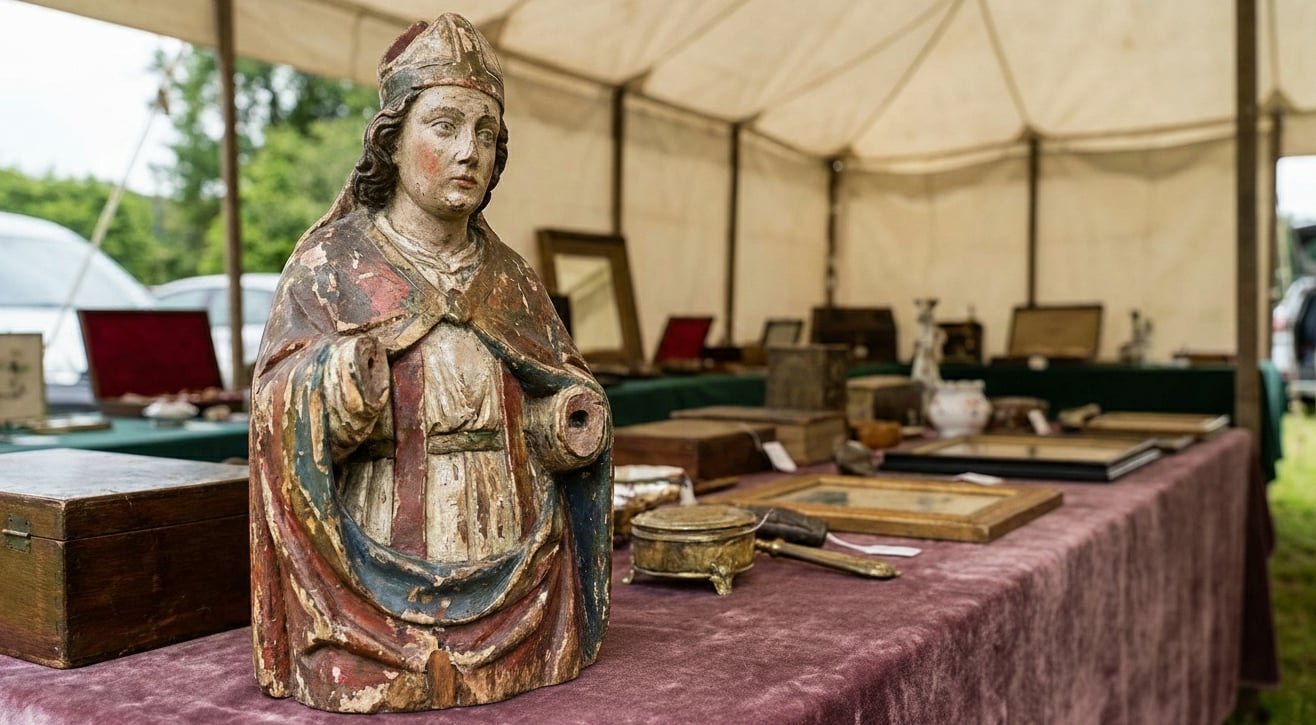
An overlooked object at an estate sale can sometimes carry centuries of hidden history.
When you get it home, it turns out your statue is a rare medieval carving that’s been on the same country house estate for hundreds of years. Fast forward a few weeks: you’ve done your research, authenticated it and established provenance. Then, almost immediately, a billionaire collector in New York makes you an amazing offer, a life-changing amount of money for you and your business!
So, the question is: Why shouldn’t you accept the offer, take the profit, export the statue and walk away into the sunset?
But before you answer that question, ask yourself these three questions:
· First — does your medieval statue actually belong to the global market, or does it truly belong to the historic and cultural lineage of its place of origin?
· Second — if we remove this statue from where it belongs, are we destroying its historical context and social significance for ever?
· Third — as traders, are we calling the deal ‘commerce’ to justify the sale and make ourselves feel better, or are we ripping a piece of history from its place of origin for a quick profit?
Those questions, in my opinion, are the core tensions, the ethical dilemmas high-end dealers often prefer not to think about – and let’s not forget, it’s not just a cultural or economic dilemma; it’s also a complex financial transaction supported by global agreements, the politics of power and national interests.
Scratching the surface, we soon see that exporting culturally valuable artefacts is propped up by international treaties, legal rulings, cultural expectations, financial interests and shifting moral norms. Some factors are clear; others are ambiguous and open to interpretation – and therein lies the problem!
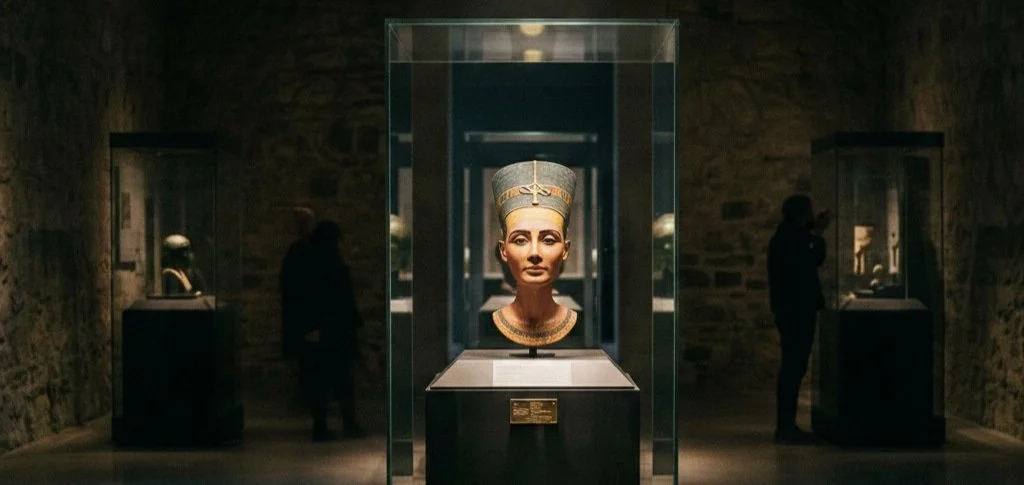
An Ancient Egyptian bust: legally exported, ethically contested ever since.
For example, consider the tug-of-war between Egypt and Germany over the excavation and export of the Bust of Nefertiti. Germany removed it from Egypt in 1913 under a legal export permit issued by the Egyptian Antiquities Service, then under French administration. The rules allowed for what they called, ‘partage’ — which divides archaeological finds between the excavator - Ludwig Borchardt and his German archaeological team - and Egypt. So, in this particular case, Germany claims they obtained the bust legitimately through the partage export agreement.
However, Egypt disputes this, arguing:
· The permit was issued under colonial-era power imbalances.
· The bust was originally mis-declared in value to secure export
· Modern cultural heritage laws would not allow the bust to be exported.
So, the bottom line is: the bust was legally exported at the time, but Egypt is making an ethical and cultural case for repatriation. This clearly demonstrates that even legal exports can become complicated. Who knows if this particular case will ever be resolved? Most likely it depends on future German politics? What do you think? Let me know who you believe should keep the bust in the comments below.
As this point in the blog, you’re probably asking: What exactly is a culturally important artefact and who defines it as such?
Good question! To attempt an answer, let’s start with the international framework that attempts to deal with this.
In 1970, UNESCO adopted the Convention on the Means of Prohibiting and Preventing the Illicit Import, Export, and Transfer of Ownership of Cultural Property.
In plain English: this means that exporting designated cultural property without a certificate is illegal but only in countries that have enacted domestic laws implementing the Convention. So, it doesn’t criminalise export itself but requires states to establish their own export control systems.
In this respect, each country sets its own definitions and rules. Some use age and value thresholds, like the UK; others, like Italy and Greece, apply controls regardless of value. In other words, there’s no global standard – typical! So, dealers must be extremely careful; lacking a certificate could make an otherwise legitimate export unlawful for a whole number of reasons that we’ll explore later in the blog.
Here’s how the process works in the UK.
If you’re exporting cultural goods that are over 50 years old, you may need an export licence — but not automatically. It depends on two things: the item’s category and its value.
In the case of an item’s value, make no mistake, the numbers matter:
In the UK, for paintings valued over £180k → a licence is required
For sculpture, ceramics and clocks over £65k → licence required
Books/maps/photos and films valued over £39,300 → licence required
Medals valued over £39,300 → licence required
And manuscripts? → Be warned, these nearly always require a licence, regardless of value!
To further complicate matters, some categories are always controlled. No thresholds. No exceptions. These include archaeological items, manuscripts, rare documents and archival material. If you’re moving any of those out of the country, you need a licence — full stop.
As a caveat, it’s important to note that these value thresholds can and do change over time. So, always do your research on current thresholds using the latest official information.
Other categories only trigger a licence when they cross the financial threshold set for that group. That covers a wide range of antiques and cultural objects, including:
Antiques and fine art
Furniture
Clocks and watches
Scientific and technical instruments
Musical instruments
Ethnographic objects
Ceramics, metalwork, silver and gold
Arms and armour
Textiles and carpets
Historic vehicles
However, if it’s archaeological or manuscript material, the rules are stricter — those require a licence at any value, no matter what. So, do your research and consult a qualified person before making that international sale!
So, the rule is simple: Your item may need a license if it’s over 50 years old, depending on its category and value.
Hit these thresholds? You need a licence.
Under it? Often, you don’t but if you’re exporting an item, always double check with an expert for your own protection!
It’s important to note that export licensing is triggered only when the item is intended to be sold abroad. Applications for export then go through the Reviewing Committee on the Export of Works of Art and Objects of Cultural Interest, the RCEWA, which evaluates items using what they call the Waverley Criteria. In short, they initially ask three fundamental questions:
Is the item closely connected with British history or national life?
Is it of outstanding aesthetic importance?
Is it of outstanding significance for study in history, art or science?
If your item meets any of the Waverley Criteria it can potentially trigger an official export deferral, giving UK buyers time to match any agreed international sale price. In this case, the decision rests with the UK Secretary of State. If a deferral is authorised, high-profile items can remain in legal limbo for an extensive period to enable the system to ensure culturally significant objects are properly considered before export – and I don’t think anyone can argue with that?
For endangered-species materials such as ivory and tortoiseshell, additional regulations apply, including CITES and APHA:
CITES is the Convention on International Trade in Endangered Species of Wild Fauna and Flora — and is the international agreement that controls the trade of endangered animals, plants and anything made from them, like ivory, tortoiseshell and certain exotic woods.
In the UK, APHA — the Animal and Plant Health Agency — is the authority that issues the CITES permits and enforces those rules. Put simply: CITES sets the global framework and APHA makes sure you follow it when you import or export-controlled materials.
In addition to this, the 2018 UK Ivory Act adds stricter rules for commercial dealing.
Ignoring these three regulations isn’t optional. High-value, historically important artefacts require due diligence - or you risk serious legal consequences, including:
At the time of publishing this video, if you ignore the CITES and APHA rules when exporting antiques or vintage that involve endangered species or ivory, the consequences are serious. Under CITES, exporting any listed animal or plant material without the correct APHA permit can carry up to 7 years in prison and an unlimited fine, with APHA enforcing compliance rigorously at the border and beyond. Under the Ivory Act 2018, exporting ivory without the required registration or exemption can result in civil penalties — including stop notices, seizure powers, and fines up to £250,000 — and, in serious cases, criminal prosecution, which can lead to up to 5 years’ imprisonment and an unlimited fine. Simply put, failing to follow the rules can put you and your business at major legal and financial risk.
So, as we now know, if an item is over 50 years old, falls into a named category and requires an export licence, failing to get one can trigger serious consequences. Customs can seize your goods and you may face civil fines linked to the value of the items — sometimes hundreds or even thousands of pounds. In more serious cases, deliberate or repeated breaches can escalate to criminal prosecution, with the possibility of unlimited fines and even prison, though most cultural goods cases focus on civil enforcement. So, the bottom line is: even perceived ‘ordinary’ antiques aren’t risk-free — doing your research and getting your export paperwork right is essential to avoid costly and legal headaches.
Don’t say you haven’t been warned!
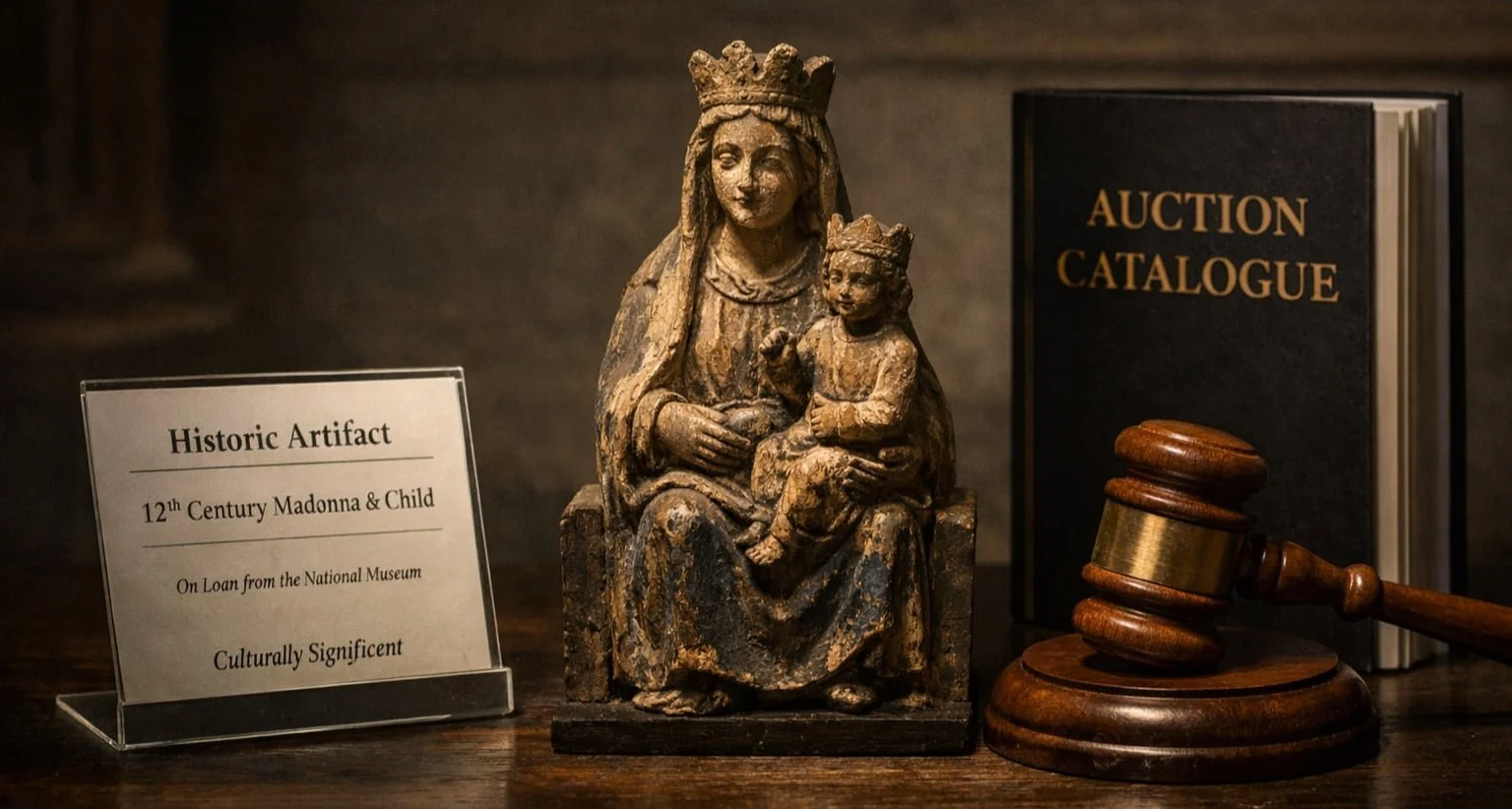
An antique artefact caught between preservation in a museum and sale at auction — where cultural responsibility meets commercial reality.
So, let’s now consider the moral, ethical and cultural considerations:
Those in favour of freedom of export argue:
Culture transcends borders; artefacts belong to humanity not individual countries.
Exports generate income for dealers and local communities.
Legal trade can prevent illicit looting.
Museums may better preserve fragile artefacts.
Opponents of freedom of export argue:
Context is crucial; removing artefacts destroys historical knowledge.
Looting persists; legal controls don’t eliminate it entirely.
Cultural heritage is tied to national identity and post-colonial justice.
Private profit can conflict with collective preservation.
So, inevitable moral dilemmas arise when:
Private owners obtain legal rights and permission to sell culturally significant items.
Not all antiques are equal; opponents of the free market claim some exports may cause cultural harm.
Legal compliance may not align with ethical responsibility.
Dealers’ therefore, have responsibilities, which include:
Understanding export licence regimes.
Ensuring lawful provenance.
Refusing deals with inadequate documentation.
To combat these moral, ethical and cultural issues, what are the future possibilities for international trade?
Perhaps, digitally sharing heritage rather than transporting it.
Partnering with museums in source countries.
Creating equitable economic models benefiting indigenous communities.
In my opinion, exporting antiques and vintage isn’t automatically wrong. Trade can be legitimate. Trade can even be good in the majority of circumstances. But let me be blunt - A trade that values profit over provenance, that ignores origin in favour of profit, that turns history into a commodity … well, that trade is broken and is wrong.
As dealers, we have a genuine responsibility when we trade internationally. As we go about our business, we are not just merchants, we are custodians of historywhether we like it or not. Every object we handle, every artefact we touch carries with it a story. A culture. A human legacy - you might even call it historical baggage!

Every antique we handle represents a choice between profit and preservation.
So, when we remove an artefact from its ancestral home, we are not just moving wood, ceramic, stone, fabric or metal. We are uprooting memory. Identity. Centuries of human experience and once that context is gone, it’s gone forever.
So, before you ship your item overseas, ask yourself these three questions:
Should it be exported?
Who benefits — just me, or the world, including the community it came from?
Does commerce serve heritage or does heritage serve commerce?
Think about it - the next time you hold a rare object in your hand, just remember: history isn’t just paper, metal, ceramic, fabric or stone. It’s life. It’s story. It’s humanity and it’s fragile. In fact, it’s irreplaceable.
The dealers who thrive in the future won’t be the ones chasing a quick profit at any cost. The dealers who thrive will be the dealers who see every artefact they trade as a moral choice, a responsibility — and who commit to protect what cannot be bought back or replaced once it’s been removed from its historical home.
What I’m really saying is: History isn’t a commodity. It’s a responsibility.
Once a story is lost… it’s gone forever and no money — not a single pound or dollar — can ever bring it back.
So, the question is simple: Are you a merchant … or a custodian of history?
Think critically. Act intentionally. Respect the past as seriously as you pursue your future.
Because every object, every artefact, every story matters.
Thanks for reading the Antiques Central Blog.
Mark Ray
If you would like to watch our YouTube video featuring this blog, click HERE.
To visit our YouTube playlist featuring antiques and vintage trade tips, click HERE.
Leave a comment below to share your memories and stories and while you’re at it, please consider subscribing to our YouTube community for more antique and vintage journeys down memory lane by clicking HERE.
